


The Mill of the Clouds
The Mill of the Clouds
Limited edition of 30 copies
History of the image
When I photographed this place, I thought I was looking at a lighthouse. The silhouette stood alone in the landscape, vertical, almost unreal. Nothing immediately contradicted this impression. It was only later that I learned it was the mills of La Boire, in Ars. The remains of a past when more than a hundred mills dotted the landscape.
At the time of the shoot, this lack of knowledge wasn't a shortcoming. It was an opening. Freed from any precise reference point, I let myself be guided by form, light, and atmosphere. The place immediately struck me as strange, almost alien. As if it belonged to another world. A marginal space, detached from any clear temporality.
Light played a crucial role. It sculpted the forms, accentuated the contrasts, while the generous and clearly defined clouds carved the sky into large masses. The whole scene reinforced this feeling of unreality, as if the landscape oscillated between reality and imagination.
It was only afterwards that the story came to be superimposed on the image.
But the image itself didn't need that to exist. Sometimes, not knowing allows us to see things differently. To open up a space where the place ceases to be merely what it was, and becomes what it suggests.


In detail
-
Digigraphie® certified fine art paper
- Support : CANSON Rag 310 g art paper, mounted on Dibond
- Printing process : pigment inkjet on matte paper
- Finish : matte, subtle texture, deep blacks
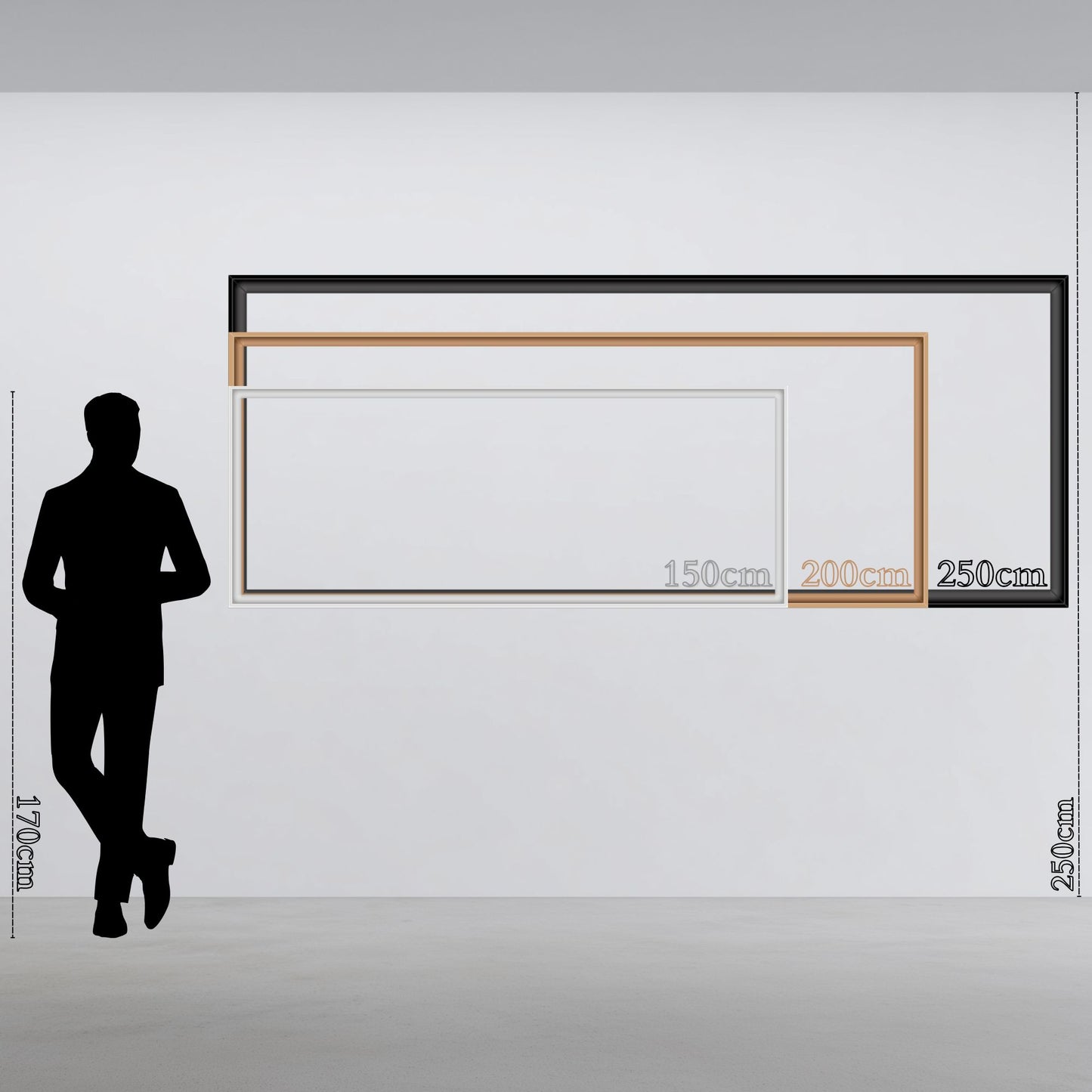
- Available sizes : up to 200 cm
-
Dibond® Aluminum
- Support : 3 mm Dibond® aluminum
- Printing process : UV inkjet printing on rigid substrate
- Finish : matte satin, no shine
- Available formats : all sizes
Two mediums, two experiences of the work
-
This collection was conceived and created on the Île de Ré, a territory with unique environmental conditions: high humidity, intense and ever-changing natural light, and living spaces unlike those of a gallery or museum. These parameters guided the decision to offer two exceptional mediums, each suited to different uses, sensibilities, and contexts.
-
The choice between Dibond aluminum and fine art paper is not based on hierarchy, but on intention: the relationship to light, the exhibition space, scale, and how the artwork interacts with its environment. Each medium was selected with the same level of rigor, in order to offer works faithful to the artistic intent and suitable for different presentation contexts.

Dibond® aluminum
Dibond aluminum has established itself as a particularly suitable technical and aesthetic solution for these conditions. Its high stability in the face of humidity and temperature variations guarantees lasting flatness, even for the largest formats. Its satin-matte finish allows for controlled light management, limiting reflections and ensuring consistent image clarity, even in very bright interiors. Minimalist and contemporary, this substrate recedes into the background, allowing the photograph to take center stage and integrating seamlessly into modern living spaces.
It also allows works to be offered in all sizes, up to 250 cm, providing a freedom of scale and deployment that is particularly interesting for large spaces.

Digigraphie® certified fine art paper
CANSON Rag Photographique II 310 gsm fine art paper, matte and Digigraphie certified, offers a more classic and tactile approach to photographic printing. This certification guarantees a printing process renowned for its fidelity, stability, and longevity, meeting the traditional standards of museums, galleries, and collectors. The matte finish was chosen to provide a smooth and uniform image viewing experience, free from reflections, and to enhance the depth of blacks and the subtlety of textures. Its subtle texture, natural white, and deep blacks offer a richness of materiality and fine detail particularly appreciated for a more intimate contemplation.
This support is offered in formats ranging from 100 cm to 200 cm, consistent with the uses and requirements specific to fine art printing on paper.

Une fabrication française
Chaque œuvre prend forme dans un laboratoire photographique en France, où des artisans du tirage et de l’encadrement l’accompagnent à chaque étape, de l’impression jusqu’à la pose du cadre.
Tout est réalisé dans un même atelier, par les mêmes mains. Ce lien direct entre les étapes permet de veiller à chaque détail : la justesse des couleurs, la qualité du papier, le soin des finitions. Ainsi, l’œuvre qui sort de l’atelier reste fidèle à l’image telle que je l’ai imaginée.
Chaque photographie est proposée avec un encadrement choisi pour la mettre en valeur et lui offrir une présentation à sa juste mesure. Pour ceux qui le souhaitent, un encadrement sur mesure peut également être réalisé sur demande, avec le même savoir-faire et la même exigence.

Fujifilm
Le moyen format, un outil à part
Le moyen format numérique appartient à une catégorie d’appareils à part. C’est le matériel des grandes campagnes publicitaires, de la photographie de mode, des reproductions d’œuvres d’art pour les musées et des commandes les plus exigeantes. On le choisit quand la qualité de l’image ne souffre aucun compromis.
Sa différence tient d’abord à la taille de son capteur, bien plus grande que celle des appareils photo habituels. Plus cette surface est grande, plus elle capte de lumière et d’informations. Il en résulte une finesse de détail remarquable, des dégradés d’une grande douceur, des transitions subtiles entre l’ombre et la lumière, et une profondeur que l’on perçoit presque physiquement devant l’image.
Cette qualité se révèle pleinement en grand format. Là où une image ordinaire perd de sa netteté une fois agrandie, une photographie réalisée au moyen format conserve toute sa précision. On peut s’en approcher, observer une texture, un reflet, un détail à peine visible de loin, et découvrir l’image une seconde fois.
Je travaille avec le système GFX de Fujifilm, qui offre cette exigence dans un appareil suffisamment maniable pour me suivre sur le terrain, au plus près de mes sujets. Il me permet de concilier une liberté de création et une qualité d’image parmi les plus abouties qui existent aujourd’hui.
Chaque œuvre porte ainsi en elle cette exigence, du moment de la prise de vue jusqu’au tirage final.

Post-production as a visual forge
Here, post-production is not defined as a quest for fidelity to reality, but as a truly sovereign space for creation. Like writing, which, from a single language, can give birth to a novel, a philosophical essay, or a newspaper article, it offers photography a plurality of modes of expression. It seizes reality to make it a fertile foundation, a rough diamond whose facets it patiently cuts to reveal its brilliance and depth.
This maturation process sometimes requires days of reflection on the approach and symbolism, transforming the captured moment into a true sculpture of light. Between documentary and poetry, post-production allows the work to transcend mere imitation and give rise to a unique, sensitive, and deliberate interpretation of the world.