


Impermanence
Impermanence
Limited edition of 30 copies
Couldn't load pickup availability
History of the image
This place fascinates me precisely because it is constantly changing. I first photographed it, in an image I called "Inhabiting the Interval ." The landscape was then stark, almost timeless. A tree. A house. A fragile balance between the sky, the marsh, and the sea.
Then came that rare event: a snowfall of an intensity the Île de Ré hadn't seen since 1985. Branches snapped under the weight. The landscape I thought immutable was transformed in a matter of hours. Faced with this, I felt very concretely the impermanence of reality. Nothing lasts. Everything is destined to change, even what seems most stable.
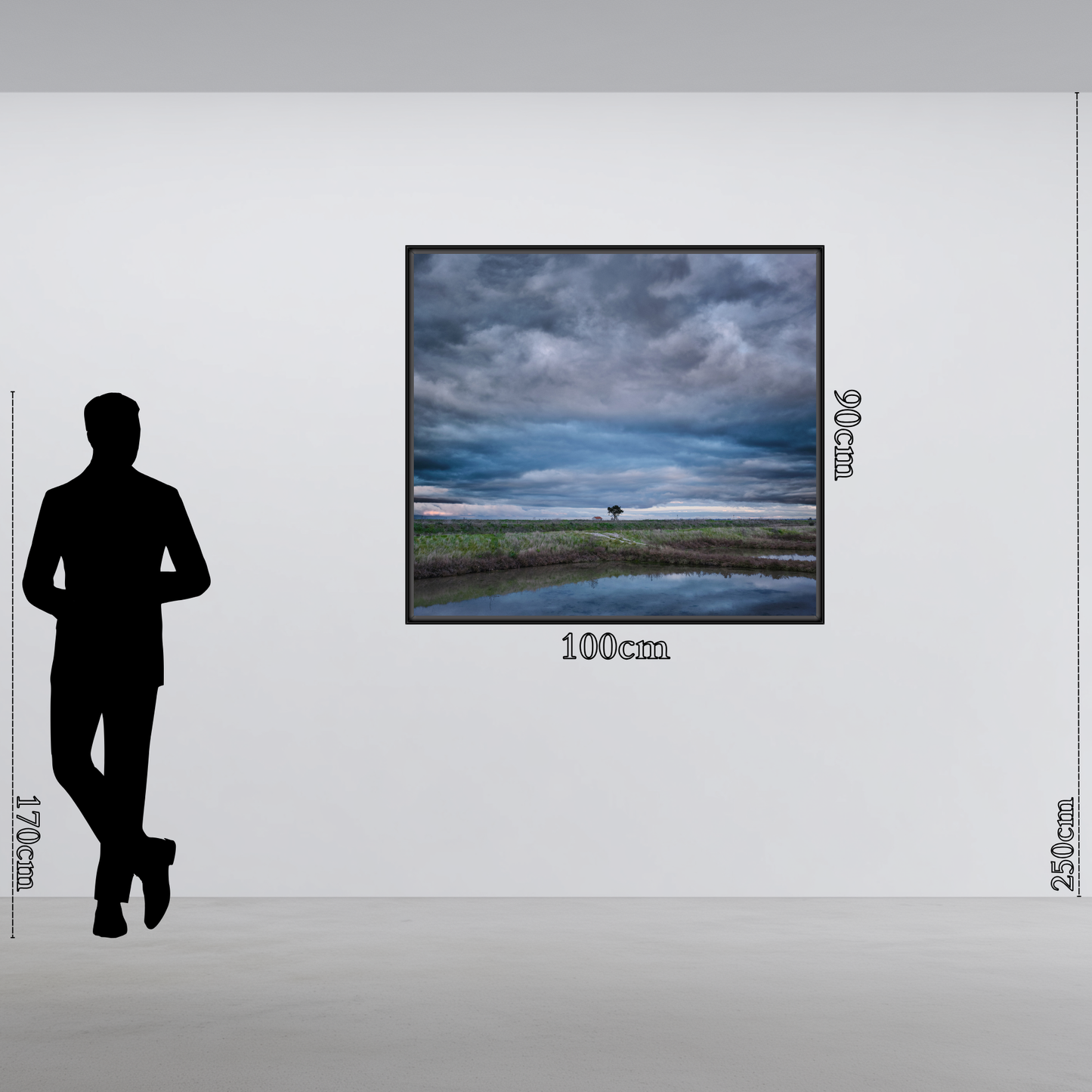
When I returned here, the scene was different. The sky was heavy, dense, deeply textured. Sunlight no longer crossed the entire sky, but persisted only on the horizon, in the form of a bluish light.
I then chose the Classic format. Not to confine the landscape, but to allow the sky to take center stage. This heavy, inhabited sky, traversed by time. Unlike the first black and white image, pure, almost abstract, this one bears the marks of passage. A new gravity. A depth.
The house and the tree are still there, but they no longer tell the same story. They are no longer simply figures of equilibrium. They become witnesses. To what has been. To what has changed. To what will change again.
I like the contrast between these two images. One speaks of apparent permanence. The other of silent transformation. Between the two, there is no contradiction. There is reality, as it is: unstable, fragile, and profoundly alive.


Delivery and lead times
- The works are made to order.
- Delivery is free in mainland France , for all sizes and finishes.
- The manufacturing time is approximately one week before shipment.
In detail
-
Digigraphie® certified fine art paper
- Support : CANSON Rag 310 g art paper, mounted on Dibond
- Printing process : pigment inkjet on matte paper
- Finish : matte, subtle texture, deep blacks
- Available sizes : up to 200 cm
-
Dibond® Aluminum
- Support : 3 mm Dibond® aluminum
- Printing process : UV inkjet printing on rigid substrate
- Finish : matte satin, no shine
- Available formats : all sizes
-
100 x 90 cm
- Retractable chassis : approximately 3.4 kg
- Framed : up to 4.8 kg
-
150 × 55 cm
- Retractable chassis : approximately 3.1 kg
- Framed : up to 4.8 kg
-
200 × 74 cm
- Retractable chassis : approximately 5.6 kg
- Framed : up to 7.8 kg
-
250 × 92 cm
- Retractable chassis : approximately 8.7 kg
- Framed : up to 11.5 kg
-
Management
- Cost price, without added markup
- Produced by the printing laboratory
- Perfectly suited to each print
-
Finishing touches and hanging
- Finish: retractable chassis / American body
- Integrated fastening system on the back.
- Wall hardware (screws, wall plugs, hooks) not included
Two mediums, two experiences of the work
-
This collection was conceived and created on the Île de Ré, a territory with unique environmental conditions: high humidity, intense and ever-changing natural light, and living spaces unlike those of a gallery or museum. These parameters guided the decision to offer two exceptional mediums, each suited to different uses, sensibilities, and contexts.
-
The choice between Dibond aluminum and fine art paper is not based on hierarchy, but on intention: the relationship to light, the exhibition space, scale, and how the artwork interacts with its environment. Each medium was selected with the same level of rigor, in order to offer works faithful to the artistic intent and suitable for different presentation contexts.

Dibond® aluminum
Dibond aluminum has established itself as a particularly suitable technical and aesthetic solution for these conditions. Its high stability in the face of humidity and temperature variations guarantees lasting flatness, even for the largest formats. Its satin-matte finish allows for controlled light management, limiting reflections and ensuring consistent image clarity, even in very bright interiors. Minimalist and contemporary, this substrate recedes into the background, allowing the photograph to take center stage and integrating seamlessly into modern living spaces.
It also allows works to be offered in all sizes, up to 250 cm, providing a freedom of scale and deployment that is particularly interesting for large spaces.

Digigraphie® certified fine art paper
CANSON Rag Photographique II 310 gsm fine art paper, matte and Digigraphie certified, offers a more classic and tactile approach to photographic printing. This certification guarantees a printing process renowned for its fidelity, stability, and longevity, meeting the traditional standards of museums, galleries, and collectors. The matte finish was chosen to provide a smooth and uniform image viewing experience, free from reflections, and to enhance the depth of blacks and the subtlety of textures. Its subtle texture, natural white, and deep blacks offer a richness of materiality and fine detail particularly appreciated for a more intimate contemplation.
This support is offered in formats ranging from 100 cm to 200 cm, consistent with the uses and requirements specific to fine art printing on paper.

Made in France
Each work is produced in a professional photographic laboratory in France, which handles all stages of production, from printing to framing, to preparation for shipping.
This complete control of the production chain allows for constant quality control, from image rendering to finishing and packaging. Printing, cutting, assembly, and packaging are all carried out in the same location, guaranteeing perfect consistency between the artistic intent and the final result. This choice of a single laboratory ensures precision, reliability, and consistency.
To encourage framing and ensure a complete viewing experience, we have chosen to offer framing at cost price. This means no markup is added to this step, so each frame remains affordable and perfectly suited to the print. Produced with the same exacting standards by the lab that creates the artwork, this high-quality framing allows each photograph to be presented in its most refined form.

Fujifilm
The GFX medium format, an exceptional tool
The GFX digital medium format belongs to a very particular category of cameras, usually reserved for high-level productions: advertising photography, fashion, fine arts or institutional commissions.
This type of equipment is distinguished by very large sensors, specific lenses, and high technical requirements. It involves a significant investment, both in equipment and expertise, which explains why it is used by a minority of professional photographers.
Originally, digital medium format was not designed for versatility or speed, but for a single purpose: to obtain the highest possible image quality, without compromise.
Richness of detail, subtlety of gradients, depth of tones and stability of rendering are the reasons why it remains the reference for images intended to be viewed in very large format.
Choosing to work with the medium format GFX means adopting a demanding and intentional approach, inherited from the standards of major productions, and putting them at the service of a personal artistic work.

Post-production as a visual forge
Here, post-production is not defined as a quest for fidelity to reality, but as a truly sovereign space for creation. Like writing, which, from a single language, can give birth to a novel, a philosophical essay, or a newspaper article, it offers photography a plurality of modes of expression. It seizes reality to make it a fertile foundation, a rough diamond whose facets it patiently cuts to reveal its brilliance and depth.
This maturation process sometimes requires days of reflection on the approach and symbolism, transforming the captured moment into a true sculpture of light. Between documentary and poetry, post-production allows the work to transcend mere imitation and give rise to a unique, sensitive, and deliberate interpretation of the world.